The following article summarizes the original event which is listed below the summary.
Fascinated with the U.S. Supreme Court
Why care about the U.S. Supreme Court? That was the issue expertly discussed by Timothy R. Johnson, Morse Alumni Distinguished Teaching Professor of Political Science and Law, during our UMRA forum on March 23.
Recounting his fascination with the Supreme Court even as a child, Johnson said the Court has become the most powerful of our three branches of government. It has the authority to determine what the law is (based on the Court's own declaration of its authority in the 1803 case Marbury v. Madison), and nearly all political questions in the U.S. sooner or later turn into judicial questions, as Alexis de Tocqueville observed in 1835.
Despite its power and role in political issues, however, the Court conducts almost all its business in private, and we know little about how the Court reaches decisions that affect all Americans, Johnson said.
Since 1995, Johnson has worked to illuminate the Court's decision-making by studying the private conference notes and papers donated to the Library of Congress by justices after their retirement. Johnson offered many examples of these notes, including those of Justice Harry Blackmun, who grew up in Minnesota and wrote the Court’s opinion in Roe v. Wade. Blackmun was a prolific notetaker during his time on the Court.
SCOTUS Notes Project
Using software to analyze the text and emotions in the justices' notes, and citizen volunteer citizen-scientists to transcribe the notes, Johnson and a professor from Michigan State University have been turning the notes into the SCOTUS Notes Project, to study patterns in decision-making over time.
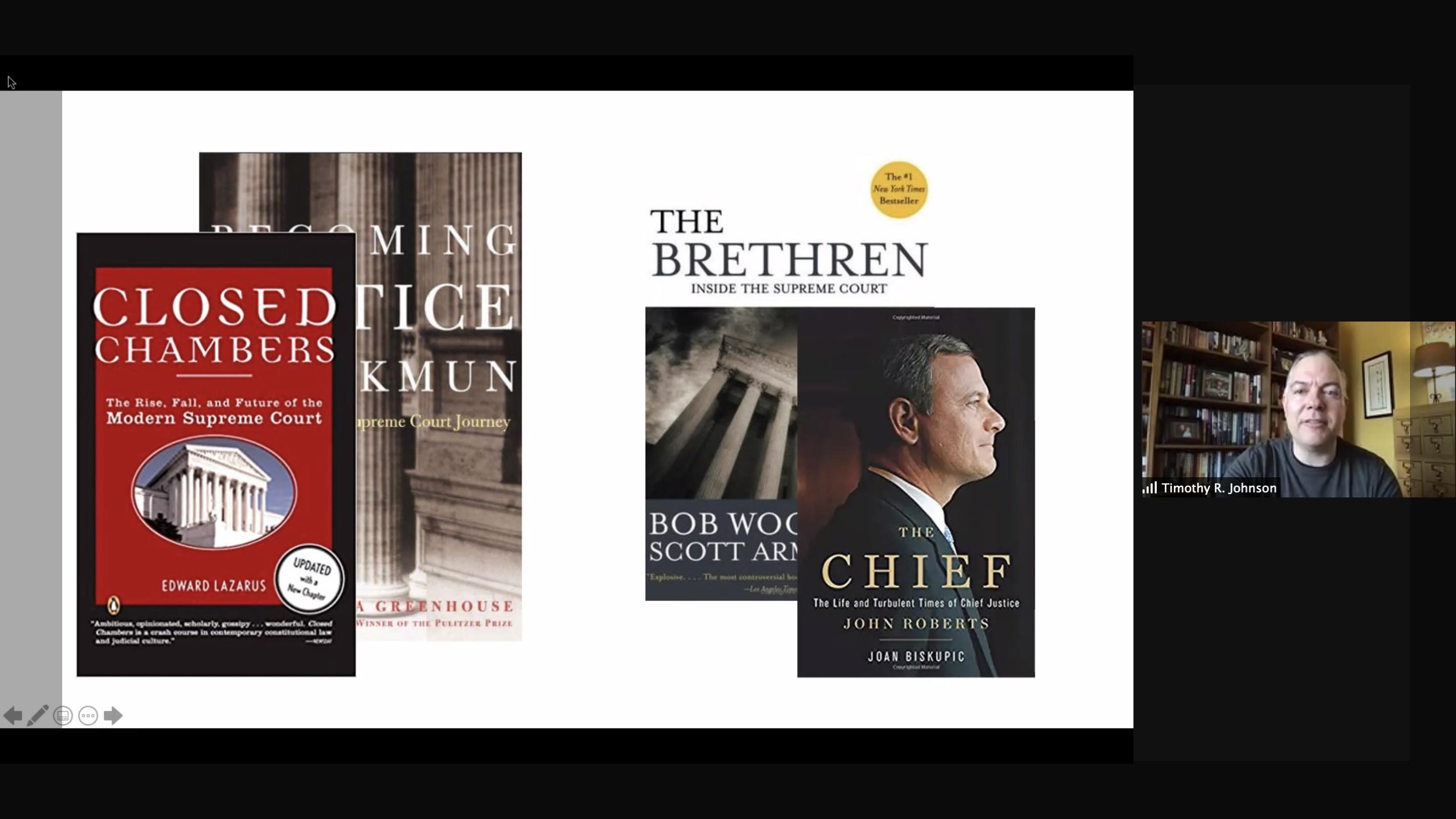
In a wide-ranging and engrossing Q and A session following his presentation, Johnson tackled questions about cases including Bush v. Gore and Roe v. Wade; possible court reforms, including expanding the size of the Court and imposing a mandatory retirement age; the spectrum of political ideologies on the Court; the scholarly approach of a historian versus a political scientist in studying the Court; questions related to the role of the Court as envisioned in the Federalist Papers; and the power of the U.S. Supreme Court compared to court systems in other countries.
Professor Johnson shared his expertise and enthusiasm on all levels. A key takeaway from his talk was this: As powerful and private as the Supreme Court is, it has not, from Johnson’s perspective, overstepped its bounds.
—Barbara Shiels, UMRA Board and Program Committee member
The Supreme Court in American society
Tue, March 23 2021, 12pm
Timothy R. Johnson, PhD
Morse Alumni Distinguished Professor of political science and law
Event to be held via Zoom.
2020 was a banner year for news from and about the U.S. Supreme Court. Regardless of one's political affiliation or perspective, the Court played a compelling role in the public life and politics of our nation.
We all know of the death of Justice Ruth Bader Ginsburg in September and the rapid confirmation of Justice Amy Coney Barrett one week before the November 3 election, when topics that once seemed dry or inconsequential, such as differing judicial philosophies, term limits, and court packing, became front and center in the news cycle.
We also likely are aware of a number of noteworthy decisions made by the Court in 2020, including rulings that: 1) afforded protections to LGBTQ workers; 2) invalidated abortion restrictions related to hospital privileges; 3) authorized states to "punish" faithless electors; 4) allowed New York to proceed with a state subpoena for then-President Trump's taxes; 5) upheld the Deferred Action for Childhood Arrivals immigration policy; 6) invalidated certain pandemic restrictions on churches; and 7) deferred a decision on whether undocumented individuals may be excluded from the U.S. census. Perhaps most consequential of all the Court's decisions were the election cases from Pennsylvania and Texas that the Court declined to hear.
But few of us know anything about the inner workings of the Supreme Court.
Professor Timothy R. Johnson is a nationally recognized and widely published expert on the Supreme Court, and you are invited to join him for the March 23 UMRA Forum, when he will peel back the layers in his presentation on “The Supreme Court in American Society.”
The U.S. Supreme Court is the most opaque of our national institutions, according to Johnson. His talk will open up the Court in ways that the public rarely sees. He will demonstrate how the justices, who are not elected and sit for life tenure, make decisions that affect all aspects of American life.
Professor Johnson is a Morse Alumni Distinguished Professor of political science and law at the University, a 2018 semi-finalist for the prestigious Robert F. Cherry Award for Great Teaching, and recipient of the 2018 American Political Science Association's Distinguished Teaching Award.
Please register and join us for the UMRA forum on March 23 starting at 12 noon.
—Barbara Shiels, UMRA Board and Program Committee member